
| ancestral chart | index | home |
An Essex County Quarterly Court record for the session of 22 Aug 1665 includes a deposition in which Reuben is said to have been about 60. Another recorded at the 31 March 1685 session says he was 86.1 These court deposition ages in general are somewhat of a mystery. Some can be verified as accurate, others are verifiably incorrect by significant amounts. Some court cases include several depositions by the same person for whom two different ages are given. For this reason, Reuben's birth year based on these records is open to speculation. His first child was plausibly born in the later 1630s
A "Ruben Guppie," son of Henry, can be found baptized on 20 February 1610 in the few bits of Bishop's Transcripts of the parish register of Thorne Coffin, Somersetshire, England.2 Guppy wasn't a common surname in England, and it occurred mostly in the so-called "West Country," including the counties of Somerset, Dorset, Devon and Cornwall. Combined with the relatively unusual name Reuben, this baptism could be significant. However, other types of records show that there were brothers named Robert and James Guppy who lived in Thorne Coffin in 1607, but nothing else was found about them.3 The missing Thorne Coffin records may have shed a lot more light on this Reuben's family. The marriage license of his parents, Henry and Margaret Boorton of Thorne Coffin, appears in the Wells Diocese records.4 The family moved to Mudford, a neighboring parish to Thorne Coffin, by 1612, where Henry and Margaret had more children.5 Margaret died there in 1628 and Henry married again to Edith How in 1631.6 Nothing further was found for any of this family. If there was more on this Reuben's siblings and parents, it might further support the theory that Reuben left England. Thorne Coffin is one of many parishes for which registers aren't extant in the 16th and early 17th centuries, so matching this Reuben with the one who emigrated isn't a given.
Court records show that Reuben had an unstable personality. He appears to have been somewhat functional, but he apparently didn't rise above a subsistance living as a laborer and couldn't provide for his children. The first record found of him is in a letter from Thomas Gorges, Governor of the Province of Maine, and John Winthrop, Governor of Massachusetts Bay Colony:7
To the Right Worshipfull John Winthrope Esqr. these present speed in Boston
Aggamenticus 1 March 1640[/41]
Most honoured Sir,
one Reuben Guppy of late comminge into our plantation and pretendinge much Religeon and a great zeal for the Ordinances of God was entertained by a planter, but since ther have come divers reports unto us of his misdeameanors with you, and that fear of punishment drove him away, and likewise this day I have receaved a letter from Captain Underhill which expresseth the desier of Mr. Endicott to have him returned which letter I have sent you heerinclosd. the desier we have to satisfy his request, and to ridd such fellows out of our Province, which have brought such a scandall on it have caused us to omitt noe opportunity of sendinge him, therfore by Sampson Salter, Master of the Makeshift you shall receave him. resolved we are that this Province shall be noe refuge for Runnaways, for none comminge from another Plantation shall be entertained heer without a Certificate of his good demeanour, or uppon the knowledge of some of the Inhabitants. thus with our services tendered to you: commendinge you to the protection of the Almighty we Rest Yours in all due respects
Tho: Gorges
The rest of the story appears in the Quarterly Court minutes for 30 March 1641.8 They say Divers complaints brought in frm divers psons ageanst Ruben Guppi as for running away to the Estward frm his wyfe great wth childe; for stealing & blasfemie, lying, swearing, etc. The courte sentence that he shalbe severlie whipped & bound wth recognizance for good behaveour and appr next court & being in testimony of good behaveor or be whipped ageane. The published synopsis of the minutes9 include snippets from testimony in the case. Robt. Pease complained that Guppi had stolen his axe...Sargeant Dixie and others had seen a hen in Guppi's breeches. Samuell Fuller and Robt Fuller testified that they went to Guppi's house, and Guppi said that he did not go to meeting and that the parings of his nails and a chip were as acceptable to God as the day of thanksgiving.
The court record shows he was sent from Maine on the Makeshift, perhaps a trading ketch, and was back in Salem by the end of March. The idea that he was in Ipswich in 1641 is a misreading of the Ipswich town records. John Kent and John Hutchins of Ipswich brought Reuben, of Salem, to court over a debt, recorded on 28 (probably December) 1641.10 The month is missing or unreadable, but the record chronology suggests December.
The two oldest Guppy children were "placed out according to order" at a town meeting on 12 May 1647.11 There is no previous order recorded. The girl went to "(Philip Veren) John Porter" until she was 18 and the boy to "(Sergt. Porter) Robert Lemmon" until he was 21. It isn't apparent what the paired names mean, but at the Quarterly Court held on 27 June 1648, Reuben agreed to bind his daughter "Marey" (some have misinterpreted this as "Marcy") as an "apprentice" to John Porter in five weeks.12 This suggests the names in parentheses were sureties. This clearly wouldn't have been a tradesperson's apprenticeship. It was another way of describing a servitude indenture, shown not only by her being a girl, but also by the original town order that says the children were "placed out." They probably went to their respective guardians as a stop-gap measure for their well-being, and the situation was formalized later. The Guppy boy isn't mentioned again, and he may have died before 27 June 1648, or the court order for his indenture was cancelled. The only known sons of Reuben were born after this, but the reference to the two oldest children implies that there was at least one who was younger, perhaps an infant. Mary married early in 1660 and had her last child in 1685. Being born about 1640-42 would mean she married when she was 18-20 and had her last child when she was in her early to mid 40s. Her brother was likely born a few years before her, with a birth succession of the boy, born about 1638-40, Mary, born about 1640-42, a child born say 1644, perhaps another born say 1646, then the recorded children John in 1648 and Reuben in 1651. There are no baptism records for these children, which isn't surprising, as records below will show.
Many of the "small suits" in which Reuben was involved imply a reckless and impulsive nature:
*28 Dec 1641. John Kent and John Hutchins, plaintiffs, debt.13
*25 Jan 1642. RG vs Mr. Scott for goods at Mr. Scott's stage.14
*vs Richard Hollingworth same session.15
*12 July 1642. RG vs Willliam Pester.16
*Dec 1642. RG vs Mr. William Payne, trespass.17
*11 July 1645. defaulting on rent and arson Robert Goodell vs RG for rent and burning a fence, charged 30 sh. 18(11 July 1645, 1:68)
*11 July 1645. was brought to court for saying, as stated in the court minutes, "that if his wyfe would had beene ruled by him, that...Michaell Sallows should have comme to his house to his wyf & he would have hidd himslef in some secret place & would have come in and taken Sallows there & so would have gotten his share of corne."19(1:82)
*11 July 1645. theft: third mention at this session, RG charged with "pulling & carriing a way the ffence of Mr. Gervas Garford."20 (1:82)
*Feb 1649. slander presented for "defaming Danyell Ray, fined or to sit in stocks."21 Feb 1649 (1:157)
*Feb 1651. Reuben "admonished for taking away Thomas Trusler's fencing stuff, the wood being of small value." 22 (1:209)
*June 1651. Some persons dwelling near Ruben Guppy complained of his wife's words and evil carriages. She was ordered to appear at next court. Reuben was bound to good behavior until the next court, and his wife ordered to appear with him.23 (1:230)
*1651 Ruben Guppy and Pasca Souden (also Sawden) testified that when they were mowing the hay for which Wm. Flynt and Daniell Rumbell were sued by old Goodman Farrington of Lynn, said Farringtou came to them and showed them the bounds of his farm, which were a great oak on one side and two pines on the other. Farrington said that where they mowed was none of his, and he knew not to whom it belonged24
*Nov 1655. brought to court for theft and not going to meeting: "admonished for stealing wood and absenting himself from meeting"25 (Nov 1655, 1:414)
*Nov 1657 brought to court for slander: accusing Richard Pitfold of beastiality and ordered to be whipped twenty stripes.26 (Nov 1657, 2:60)
*June 1682. convicted at the session for selling liquor without a license, fined 5 shillings, he only paid 30 pence.27 ()
*June 1674. Higginson28
Reuben did function normally enough to serve the town as a hog warden for ten years. He was appointed as such on 14 March 1670. He would have been involved in making sure the pigs were "properly ringed" (in the nose) when they were in the town common land before 19 March and yoked (to prevent them from rooting in the ground) by 1 June. He would get the twelve pence fines from anyone not adhering to this, if any.29 He was appointed again on 6 March 1671, but refused.30 He apparently did agree to this position on 20 March 1674, 31 15 March 1675, 32 15 April 167633 and 5 April 1680.34 Also, on the latter date, Salem ended the practice of letting pigs have free run of the streets. Anyone was allowed to take them if found and either keep or kill them. Half of either proceeds were to go to them and the other to the town's poor. Reuben was among them men to oversee this.
On 20 April 1676, the town ordered that boys were to sit on the three pairs of stairs in the meeting house on Sunday. William Lord was to oversee the pulpit stairs and Reuben the others. Reuben was also appointed to keep dogs out and was abated his taxes in payment.35
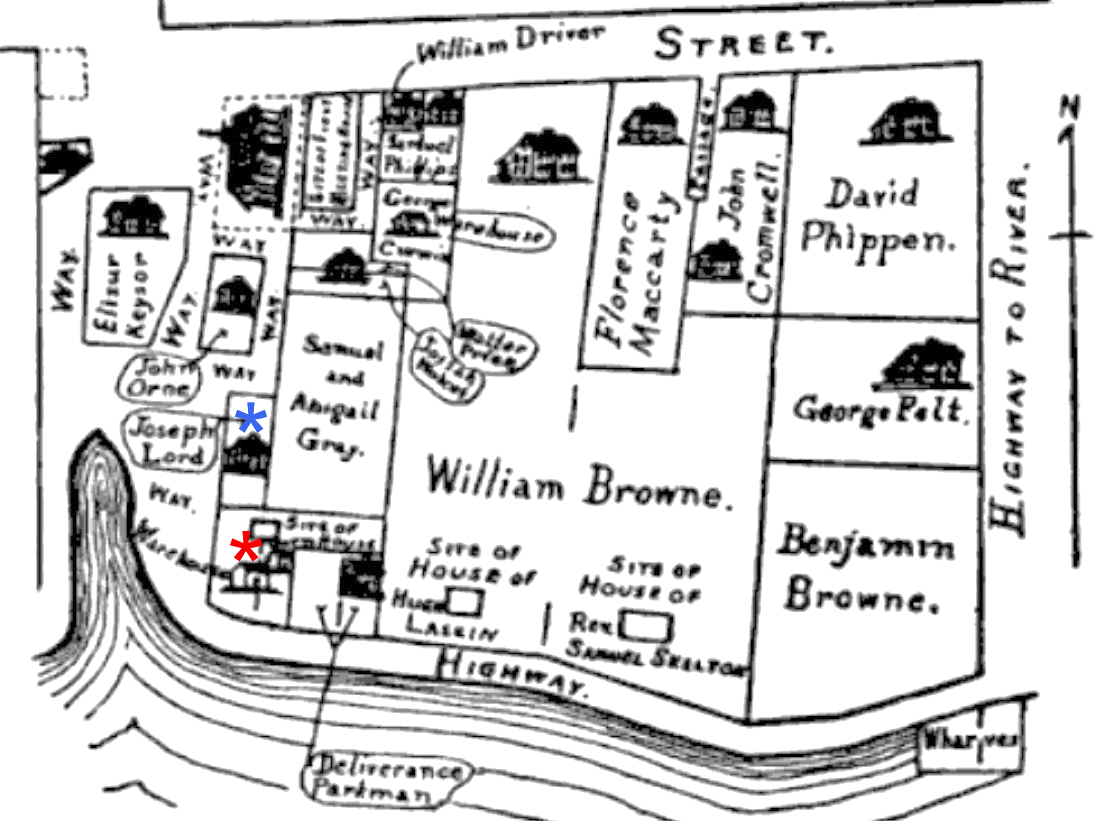
Records aren't clear as to where Reuben lived in Salem, but it seems to have been at what is now the corner of Washington and New Derby Street. New Derby Street was originally called Front Street and ran along what had been the old edge line of the harbor. Reuben was given a small piece of land there "at the end of Obadiah Rich's house" on 24 March 1674.36 He sold this on 24 December 1679 to William Godsoe and is described as being between William Lord and the water side.37 This was all at the corner described above. The Guppy family's land was mentioned in 1675 when the foot company of militia was divided by location. The lower company was to "begin at John Price and from Reuben Guppy to John Guppy down to Mordecai's Neck."38 Sidney Perley, in his "Salem in 1700" work,39 places John to the north at the northeast corner of Washington Street and the edge of the North River. A court case in 1683 refers to Reuben's neighbor William Godsoe transporting goods into "Ruben Guppey's cove" not only on Sunday, but during the church service. This may have been the small inlet that shows on earlier maps where Washington Street ended at the harbor.
Although....calls him a husbandman, this doesn't make sense, nor was a record found to support it. In the county court records, His first deposition says that he was employed mowing salt marsh thatch, which was then, as the accusation went, taken away by someone else illegally. The second was about the ownership history of a lot on which he was again hired to mow.
Reuben's taxes were abated by the town a number of times:
*12 May 1647, £1, 8 shillings.40 (Town Records of Salem, Massachusetts, vol. 1 (Salem, MA: Essex Institute, 1868), 152)
*19 November 1669, 10 shillings.41 (2:105)
*7 January 1669/70, 3 shillings, 4 pence 42 (2:108)
*20 February 1670/71, 3 shilling, 4 pence.43 (2:1210
*26 Feb 1682/83, 7 shillings, 6 pence.44 (3:86)
On 29 July 1684 Reuben, his son John and John's wife Abigail were involved in a case about a group who broke into and stole money from George Corwin in Salem the previous March.45 The record is vague, but Corwin appears to implicate the Guppys in the some aspect of the crime. Some of the primary players, as well as Corwin himself, were the Guppy's neighbors. Reuben testified, again being referred to as about 86, but relayed information from his son John, who in turn knew only heresay about the crime. No testimony implicated their participation and there was no action against them.
On 8 June 1715 John Guppy, a tailor, sold the cottage and cottage right where his he had lived and owned previously by his father.46 A house had been built on the lot before 1661, implying that it was the house John grew up in. Cottage rights allowed people to live in a small house on town land. (?Reuben and John sold their lots mentioned above. Where they were after this hasn't been located). John must have inherited this property and kept it, while living elsewhere.
Children of Reuben and Ellen or Eleanor Guppy:47
* son, b. say 1639 or Spring 1641, old enough to have been "put out" to another family on 12 May 1647.
* Mary, b. say 1639 or Spring 1641
* other children, b. abt. 1643 and 1646, since the son and daughter put out in 1647 were the two "oldest" children. These may have been daughters or sons who died young, since Mary, John and Reuben, Jr., were the only children who appear in records.
* John, b. 12 Oct. 1648
* Reuben, b. 6 Jan. 1650/51

1. Records and Files of the Quarterly Courts of Essex County, Massachusetts (hereafter ECQC), vol. 3 (Salem, MA: Essex Institute, 1913), 276, and vol. 9 (Salem, MA: Essex Institute, 1975), 344, 438.
2.
3.
4.
5.
6.
7."Winthop Family Papers," Massachusetts Historical Society, online database, https://www.masshist.org/publications/winthrop/index.php/view/PWF04p324.
8. original minutes
9. 30 March 1640/41, 1:25.
10. The Ancient Records of the Town of Ipswich, vol. 1 (Ipswich, MA: 1899), 20.
11.Town Records of Salem (hereafter STR), vol. 1 (Salem, MA: Essex Institute, 1868), 151.
12. ECQC, vol. 1 (Salem, MA: Essex Institute, 1911), 143.
13. ECQC, 28 Dec 1641, 1:38.
14. ECQC, vol. 1:30.
15. ECQC, 1:32.
16. ECQC, 1:42.
17. ECQC, 1:45.
18. ECQC, 11 July 1645, 1:68.
19. ECQC, 1:82.
20. ECQC, 1:82.
21. ECQC, 1:157.
22. ECQC, 1:209.
23. ECQC, 1:230.
24. ECQC, vol. 2 (Salem, MA: Essex Institute, 1912), 213.
25. ECQC, 1:414.
26. ECQC, 2:60.
27. ECQC, vol. 8 (Salem, MA: Essex Institute, 1921), 343.
28. Higginson.
29. Town Records of Salem, Massachusetts, 2:110.
30. STR, 2:124-5.
31. STR, 2:187.
32. STR, 2:201.
33. STR, 2:208.
34. STR, 3:3-4.
35. STR, 2:210.
36. STR, 2:188.
37. STR, 5:54 or 249.
38. STR, 2:199.
39. The Essex Antiquarian vol. 11 (Salem, MA: 1907), 115-6.
40. Town Records of Salem, Massachusetts, vol. 1 (Salem, MA: Essex Institute, 1868), 152
41. 2:105.
42. 2:108.
43. 2:110
44. 3:86
45. ECQC, 9:273, 281.
46. Essex Co., MA, deed 29:104.
47. John and Reuben's births are from the Essex County Quarterly Court annual vital records returns and are included in Vital Records of Salem, Massachusetts, to the year 1849, vol. 1 (Salem, MA: Essex Institute, 1916), 394.