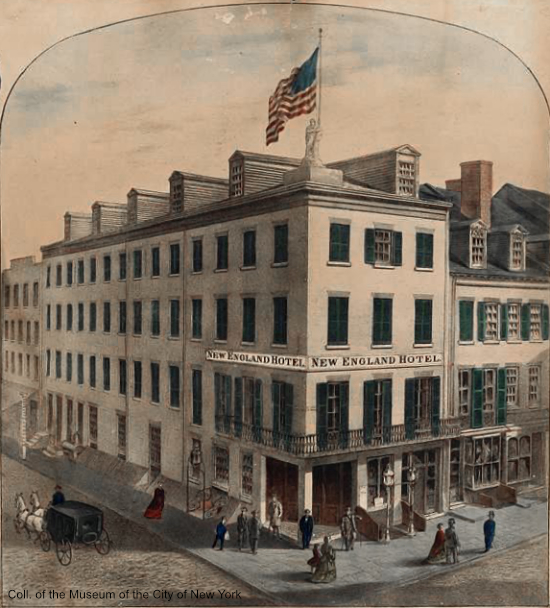
Jonas, Harriet and their brand new baby Sarah moved to New York by City about late July 1834.1 In 1835 he appears in a city directory as proprietor of the North American Hotel at 30 Bowery, corner of Bowery and Bayard Streets. By settling here, the Bartletts found themselves in the middle of a "plebeian recreation zone...Working people gravitated there after hours, attracted by the life and color, the array of services, and above all the vitality of crowds of people determined to have a good time."2 It was, in many ways, similar to Times Square in the last quarter of the 20th century.
Old Bowery Days says of the North American, previously the New England Hotel, that "Its front was surmounted by a wooden statue of a ragged boy, gaudily painted and supposed to represent the proprietor, Peter B. Walker, in the early stages of his career. It was a favorite stopping place for performers from the indoor circus across the way, and they might be seen o'noon-times in flashy attire, lounging about its door. The hotel was likewise a Native American and Know-Nothing headquarters for several years."3
Despite some of the rough associations, a travellers guide named it among the principal hotels in the city.4 No reference has been found about Jonas' political leanings in the 1830s, but he was very likely then what he was later: a Whig. It was no different than modern political parties and had its factions. Some meetings at the North American were politcally extreme, expressing the strongest anti-Catholic and anti-immigrant feelings ever voiced in public, but if Jonas was a sympathizer, it isn't yet known. When the Whigs took the seats of the mayor and the common council in 1837, Jonas hosted a "grand Whig dinner" for two dollars a head.5 The New York Herald and The New York Spectator were politically allied, but not to each other. The Herald ridiculed the celebration: "...the grog shops were in their glory, so was Niblo's, Adams's [sic], Welsh's, and the North American Hotel in the Bowery...Tallow candles out of number were burned, until they burned themselves out...The men [who were to march in the evening parade] had been walking into wine, whiskey, and brandy the whole afternoon [and] were just able to steal off to bed...whence they arose this morning sick, sorrowful, sleepy and stupid."6 This was typical of the Herald, the snarky and vitriolic content of which was controlled by Scottish immigrant James Gordon Bennett. The Spectator was less overtly biased, and said that it was a "proud festival" and that "many of the public and private houses of the city were brilliantly illuminated. Among those which came under our notice were...[the] North American Hotel."7

| previous page |
1. Stanton Smith said that they moved when their daughter Sarah was six weeks old, placing the move in July. The 1855 New York State census (Kings Co., 1st Ward, 2nd ED, dwelling #191) says that Jonas, Harriet and Sarah had been living in New York city for 21 years.
2. Edwin G. Burrows, Mike Wallace, Gotham, A History of New York City to 1898 (New York: Oxford University Press, 1999), 642.
3. Alvin Fay Harlow, Old Bowery Days (New York: 1931), 219.
4. John Disturnell, The Traveller's Guide Through the State of New York, etc. (New York: 1836), 19.
5. The New York Herald, 21 Nov 1837.
6. Ibid, 24 Nov 1837.
7. The New York Spectator, 24 Nov 1837.