While Jonas was running the North American Hotel, he showed the first known inclination toward show-business. On 14 January 1835 the Zoological Institute was created in Somers, New York.1 Jonas's signature appears among other owners and investors as co-founders. While their aim was presumably to organize and promote animal menageries, it was generally considered to be an attempt to control and profit from all of such travelling shows in the country. This they did for several years before the venture fell apart.fn (Boston Zoological) Jonas would have been at least acquainted with most or all of the major circus and menagerie owners (and performers) after he took over the North American Hotel, the Bowery being the favorite gathering spot for that crowd. He undoubtedly was an investor at first, a "silent partner" perhaps in some of these shows. In June 1839 he took a more active role. He became a partner with veteran circus owner Rufus Welch and bought the failing Bacon & Derious Circus Company while it was performing in Richmond, Virginia.2 They renamed it the Grand National Arena Company under the business name of Welch, Bartlett & Company. In July he joined with Welch and an entrepeneur named John Clayton to buy the New York Circus & Arena Company from Hall, Nathan & Tufts.3
At the time, each of these companies gained a female giraffe. The backgrounds of these giraffes is an interesting story.
Clayton was a Scottish native living in South Africa when members of the Zoological Society went there to investigate getting "exotic" animals. He and a Mr. Bain had been hired to go on separate expeditions for them. Of particular interest were giraffes.(Weeks' death: Porter's Spirit of the Times, 25 July 1857, p. 329) Mr. Bain's attempt went afoul with local tribes, but Clayton eventually succeeded, funded by Rufus Welch, Caleb Weeks and possibly others.
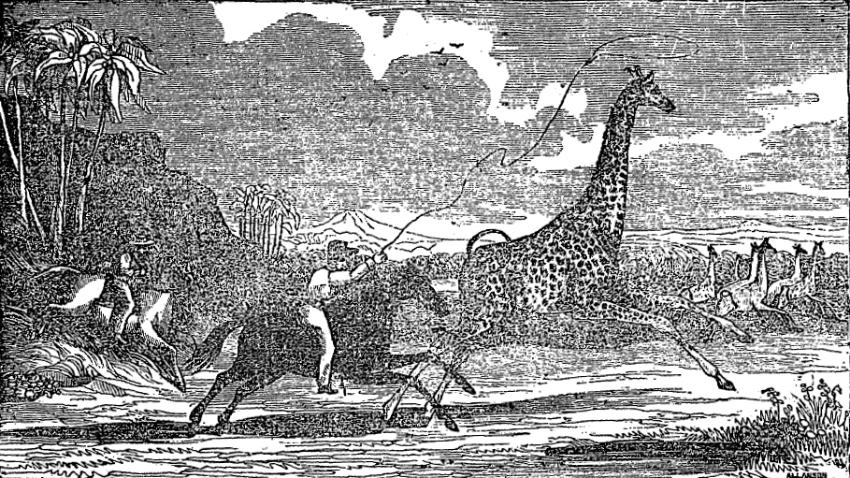
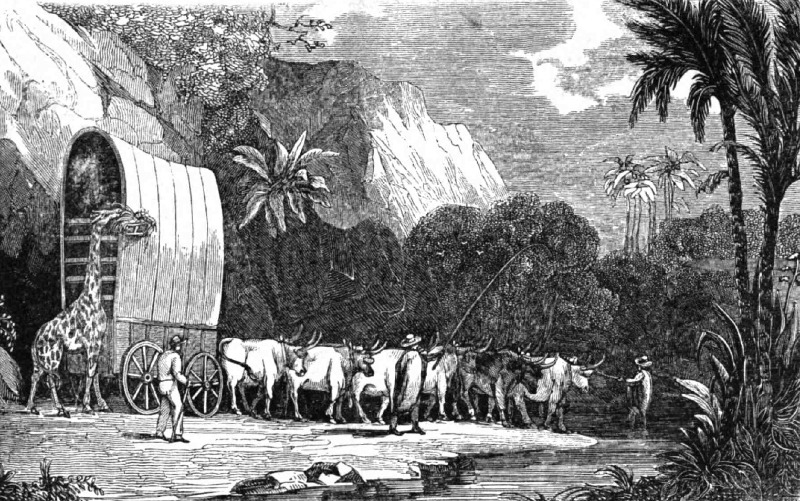
The hunt for the giraffes is a sad story. The hunters caught them by chasing them on horseback with a lasso, but the animals, obviously, struggled for their lives in the process. The capture, if successful, was traumatic enough, but they went after young animals still at least partially dependant on their mothers. "In these struggles many giraffes expire - and even after they are secured and placed in the wagons, they become so mutilated by struggling as to die within a few days."4 This first expedition resulted in a large and varied collection of African animals for menagerie partners Macomber and Handy, but no giraffes for Welch and Weeks. "Mr. Clayton succeeded in bring[ing] four fine foals several hundred miles on his way back to the Cape, but all of them at length died for want of milk, or other delicate nourishment suited to their age."
Apparently Welch and Weeks provided enough cash to make another giraffe expedition possible. They were better equipped and managed to capture eleven giraffes on the eastern edge of the Kalihari Desert, seven of which died on route back to the Cape. Of the remaining four, one died of an "abcess" and another was fatally injured when it was being loaded onto the ship to be taken to New York. Two survived the passage across the Atlantic in specially constructed berths. The whole process took about three years.
The two giraffes arrived in New York on the bark Prudent from Cape Town in June 1838.5 The trip took forty six days with a stop at St. Helena Island. The ship had been hired for the purpose of transporting the giraffes after Welch and Weeks got word from Clayton that they had several alive in Cape Town. Welch and Weeks went to South Africa with the boat and came back with the giraffes, Clayton and Henry Jones, a 28 year-old English man, purpose or service unknown. The passenger list calls Clayton, Welch and Weeks "naturalists," a term popular at the time for anyone collecting animals, vegetables and minerals on the more or less professional level. It's been suggesting in print, but with no proof given, that Jonas was a partner in this venture. He, and others, may have been backers, but left no extant paper trail to prove it.
The giraffes were first exhibited on tour by Clayton in 1838 into 1839, then attached individually to the two circuses co-owned by Jonas and Welch. The New York Circus & Arena Company combined with one of Clayton's tours to become the New York Circus and Giraffe Exhibition United about December of 1839.
Shortly after the giraffes started to tour with the circuses, The Youth's Companion published an article about them and one of the venues. "The Giraffe, the Ibex, the Bontibok and the Gazelle are exhibited now in Boston. The proprietor intends to take them as far east as Portland - stopping at intermediate places. The Editor of the Youth's Companion has seen this interesting collection of animals and would recommend his young readers to visit them. They are not dangerous creatures but perfectly harmless and delicate - the gazelle especially is a beautiful little creature."6
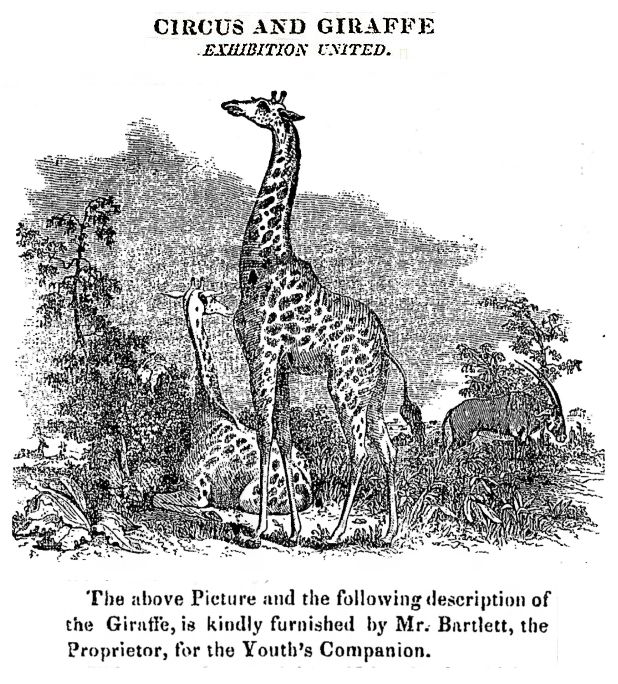
The New York Circus and Giraffe Exhibition United toured from Pennsylvania to Georgia and points west out to Ohio over the next year-and-a-half under Clayton's managemet.7 he roster for this show was modest. Aside from the giraffe, there was a vaulter (one of the Lipmans?), five horse trick riders, a minstrel (two minstrels?)and an armless man.8 A Savannah paper reported the show:
In the first place, there is a deception practiced, in inducing people to go at seven o'clock, under the belief that the performance in the ring takes place at that time. After the audience are all comfortably seated a man comes forward and proclaims that the performance of the man without arms will now commence and those who choose to pay an additional 25 cents can see him, those who don't may wait here until he is through. Now, all those who have a horror of seeing a deformity in any shape, have a very comfortable time of it, looking into the innocent face of the giraffe while he looks into their simple faces.
The next thing we object to is the amount of labor imposed on those two poor little boys [the two minstrels? Annal of the American Circus seems to call them apprentices]. About one-half of the performance, it seemed to us, fell to their share. This, no doubt, had its origins in the fact that they are very popular with the audience, but even the demands of the popular will should not be put in the scale with the duties of humanity. On the whole we were well enough pleased.9
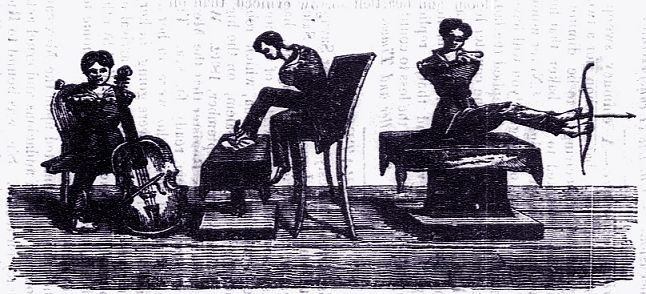
The armless man was Sanders K. G. Nellis, a native of New York's Mohawk Valley. He was very agile with his legs and feet, and had been displaying his talents since he was 11, opening in Baltimore in 1828.10 He was at the Maryland Museum, and this was billed as his first public performance. He is sometimes erroneously called "Saunders." The following woodcut accompanied a later advertisement.
After appearing in Christmas shows in Mobile, Alabama, they went to Havana, Cuba, early in 1841.11
A New Orleans paper said "her ladyship Miss Giraffe will probably create as much sensation [there] as her ladyship Miss Elssler."12 Fanny Elssler, a very popular ballerina who had also been touring the southern states, debuted in Havana several weeks later, but was a solo act there.13 Details of the circus in Cuba have yet to be found, but the five equestrians were definitely there, with a sixth added at some point. They appear together on a ship's manifest, arriving in New York City from Havana in July of 1841.14 So to were Nellis and two other "comedians," who arrived on 3 May.15 Levi North, a prominent equestrian and gymnast, also arrived from Havana in May.16. It's most likely he was hired as an independent performer, but he was also on roster of another Welch & Bartlett circus in 1840, which will be covered later. Clayton, with the giraffe and circus-related businessmen, made a trip from Havana to New Orleans in April.17 North may have been added to the roster specially for Havana, but he at times performed independent of larger shows. It's likely not a coincidence, though, that he was there at the same time as the circus. Clayton and the giraffe continued to tour, heading north, (see note 1) and the research trail has (so far) ends in New Brunswick, Canada. A newspaper notice says that the giraffe died while heading south from St. John in that province.18
The Grand National Arena Company, the other circus co-owned by Jonas, started small, with a ringmaster, 3 riders, a clown, a vaulter, a minstrel and an acrobat (with the added attraction of the second giraffe), but after touring New England, New Jersey and Pennsylvania, they settled in Manhattan for the winter and had an elaborate cast.19 Added to the company were 7 riders, two of whom were women, 4 acrobats, a contortionist, 2 clowns, a vaulter, 7 minstrels, a tight-ropist, a juggler, a singer and Harvey Leach, the "man-monkey," whose stage name was "Hervio Nano." The New York Herald reported the event over several days. "Signor Hervio Nano, a queer creature - according to all accounts - with a queer name" had rehearsed to the point of exhaustion the day before he was to open his act and the performance was postponed. "The astounding dwarf was engaged during the whole of yesterday in rehearsing his wonderful performance such as scaling the proscenuim and crawling across the dome of the theater by the mere muscular force of his arms and hands and still laboring under the effects of a long and stormy voyage."20 The giraffe was no longer with them. She had died the previous November while travelling in New Jersey at the end of the tour.21 It was speculated that it was related to the cold atmosphere, but no cause was ever made public. It was later said, and often repeated, that she fell and broke her neck, but no comtemporary evidence of this has been found. It may be that she fell but couldn't get up again, which is a danger to all giraffes. It is all the less probable, though, given that the giraffe was not likely travelling on foot. Menagerie and circus wagons were widely in use by then.

| previous page |
1. Westchester County Historical Society archives, articles of agreement, images online at https://www.westchesterarchives.com/HT/muni/wchs/zoological.html.
2. This is stated in published and online circus histories with no sources given.
3. See note 2.
4. New York Mirror, 66.
5. New York Spectator, 11 June 1838, arrived same day; passenger list, Port of New York, bark Prudent, 7 June 1838, NARA microfilm publication M237, roll 36 (Washington, D.C.: National Archives and Records Administration).
6. citation needed.
7. Examples from newspapers: Adams Sentinel (Gettysburg), 6 Aug 1839, 3; Daily Herald & Gazette (Cleveland), 22 June 1839; Macon Weekly Telegraph (Macon, GA), 31 Dec 1831, and others including Boston, New York State, Virginia, North Carolina and Alabama.
8. ship manifest, SS Clarion, 27 July 1841. John J. Nathan (24) of Phildelphia, William and Edward Kincade (ages 8 and 10) of Baltimore, Edward Kelly (19) of Troy, Walter Howard (30) of Louisiana and Saul Lipman (28) of Philadelphia. Also Raphael Quintana (23), musician, of Boston.
9. Daily Republican (Savannah), 27 Jan 1840, 2.
10. Baltimore Patriot, 16 Dec 1828, 4.
11 Times Picayune, 13 Jan 1841; Ibid, 20 Apr 1841. Elssler made her debut in Havana on 23 Jan.
12. Ibid.
13. arrived 15 Jan, Alexandria Gazette, 2 Feb 1841, 3.
14.ship manifest, SS Clarion, 27 July 1841, John J. Nathan, William Kincade, Edward Kincade, Edward Kelly, Walter Howard, Saul Lipman, also Raphael Quintana, musician.
15. ship manifest, "Hellespont," 3 May 1841. The others were Levi and Lewis Hammond.
16. ship manifest, SS Clarion, 1 May 1841, "Levy North," equestrian.
17. ship manifest, SS Natchez, 19 Apr 1841; Times Picayune, 20 Apr 1841, p. 2.
18. Detroit [MI]Times, 23 July 1841.
19. John H. Glenroy, Stephen Standley Stanford, Ins and Outs of Circus Life (Boston: 1885).
20. Evening Post, 29 Jan 1840, 2.
21. Atlas (Boston), 13 Nov 1839; Northern Journal, 21 Nov 1839, 3.