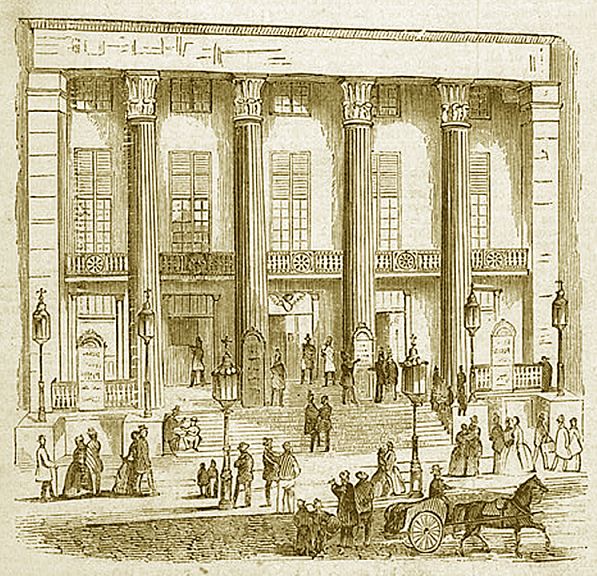
The Bowery Theatre, third building (1839-1845)
The Broadway Circus went on the road for the rest of 1840 in Massachusetts and New York. On 10 November they opened for a Winter season at the Bowery Theatre.1 "Legitimate" theatrical performances were not getting the customers they needed to stay in business in the Fall of 1840. James Gordon Bennett, before-mentioned editor of The New York Herald, had a particular loathing of Bowery Theatre manager and actor Thomas Hamblin, who was dependant on ticket sales to his dramatic performances. Bennett delighted in his misfortune.
THE BOWERY [Theatre] - The drama of Greysler, from Hoffman's popular novel, is an entire failure. It was played to $61 on Monday night, and there was hardly as much in last night. Hamblin is a gone coon - neither water tanks [which he had installed at a large expense] nor saltpetre will save him. We understand that he is negociating with Welsh, the proprietor of the Broadway Circus, with a view to introduce horses, and play equestrian pieces. He had better get sea horses, and put them into his water tank - that would be a novelty indeed.2
When the circus opened, it had transformed into a showcase of equestrian drama. Although vaulting and gymnastics were still on the program, the features were melodramatic plays written specifically to be done in an arena with many actors on horseback, and with as many mechanical and scenic tricks as possible. These spectacles originated in England between 1810 and 1820 and were best-known from performances at the Astley Theatre in London. The Bowery would have to have been extensively remodeled to accomodate such a show, creating an arena in addition to the stage so that there would be about a three-quarter round view of the performance. Hamblin's water tank was put to good use for some of these scenes.
Aside from a smaller-scale equestrian drama "St. George and the Dragon," the featured piece was "The Battle of Waterloo." To get an idea of the scale of the performance, 50 horses and 200 extras were employed. Following this through December were "Mazeppa" and "The Phantom Spectre," which had also been established in England. While the spectacle of them might draw people to a Broadway theater today, the writing wouldn't. An example from "Mazeppa" has one of the lead actors cry out "Prepare strong hempen lashes around the villian's loins...let scorching sun and piercing blast, devouring hunger and parching thirst, with frequent bruises and constant motion render the Tartar piece-meal!"3
The smaller acts in program of these shows were also meant to impress. Hamblin, the proprietor of the theater, had hired Welch and Bartlett to put on their show, and he hired others to add to the bill. He did so from the best available equestrians, gymnasts and character singers and actors. Levi James North, an American equestrian gymnast, had performed to fame and acclaim in England in 1839 and 1840. He had agreed to perform for June, Titus, Angevine & Company at the Amphitheatre while he was still in London. When North arrived in New York City on 13 November 1840, having described himself for the ship's passenger list as an "artiste," the employer considered this a binding, verbal agreement. The employee didn't. North postponed his opening night appearance on the 18th and then accepted a better financial reward for signing with Hamblin to appear at the Bowery Theater. His first night there was on the 23rd4 The Amphitheatre appears to have quickly countered by hiring Timothy V. Turner, also an accomplished equestrian, although not of international fame. Competition being what it was, between theaters and performers, it probably wasn't coincidence that Turner, on the first night of both his and North's appearances, performed a somersault on the back of a moving horse and landed on his feet - an act that hadn't ever been done in public. Edward Kendall, a very popular buglist, debuted the same night as North. Combined with the "The Battle of Waterloo," this entertainment program was one of the most impressive and perhaps the most expensive the city had ever
seen.
The Herald published this commentary:
The Bowery, since the accession of Welsh to the sceptre, has gone ahead like a steamboat. From being at the very lowest ebb in the estimation of the play goers; it has at once sprang into the very first rank, and became almost the feature of the town. People may ask how this is; but it all resolves itself into two elements, novelty and enterprise. Had Welsh not stepped in with his capital to make the necessary alterations, and been prepared to furnish the 'materiel,' in the shape of men, arms and horses, why the Bowery would have gone from bad to worse, until by this time next year we should have had Parson Burchard preaching from the first tier of the house. This catastrophe has been averted by changing entirely the system on which Hamblin had been working, exhibiting himself, Mrs. Shaw, and some half dozen more hacks, to three noisy boys in the pits and some half dozen wheezy faced individuals in the boxes, and we will not say how many rowdies in the third tier. Now the establishment is in the highest tide of success and does not even fear the opposition, or the lions which are to be set a going on the other side by Titus, Angevine & Co.5 Herald 11 16 40
Despite the razzle dazzle and James Bennett's hyperbole, the theater did poorly. The Herald speculated why this and the legitimate drama houses were in danger of closing, but in hindsight, for the Bowery Theatre, it was the uniquely high prices of tickets. As manager of the theater, Hamblin set the prices, perhaps trying to recoup production costs as quickly as possible. By the end of the year it was obvious the theater would have to close. It may have been about this time that the theater's treasurer, John De Peyster Champlin, tried to commit suicide, or so Hamblin and a doctor claimed. Hamblin apparently fired him and the doctor committed him to a mental hospital.6 Champlin sued them both for false imprisonment.
Early in January some sort of arrangement was made that had Hamblin step aside to allow Rufus Welch, Jonas Bartlett and John Champlin to take over the theater's management. Welch, Bartlett & Company sent their horses down to Philadelphia temporarily and closed the theater for a week. When shows started again on the 11th of January, the admission price was lowered.7 Advertisements announced the company for the first time as "The New York Circus." This was also the first time "Welch, Bartlett & Co." were named as proprietors, replacing Hamblin. During their haitus and a week of relatively small productions, the company was ready to start another Napoleanic epic equestrian drama (called "Napolean"). The theater began to draw crowds and its fortunes turned. "Napolean" was followed, not surprisingly, by "The Invasion of Russia, and the Burning of Moscow," starring Napolean. "The Cataract of the Ganges" was next, ending with "El Hyder." When the season closed, the Bowery Theatre had eclipsed the Amphitheatre in popularity.8 In the process there was a benefit given to widows and orphans of New York City firemen. The theater was opened on two occasions specially to officers and students of the naval academy in Brookyn and to children of a "deaf and dumb" institute. Ex-president Martin Van Buren attended a performance on March 23rd.
Levi North had agreed to perform up to March 11th, when he probably left for an engagement in Cuba.9 The Herald of March 13th says "T. V. Turner, the only vaulting equestrian in the United States is engaged, and appears on Monday in his famous principal act - somerseting over the canvas during his horse's speed, &c." There is confusion in print about who was the first to perform a somersault on the back of a moving horse. Turner and North have both been given credit, but this act was more complicated than armchair historians apparently knew about. Both men were clearly described in notices and ads as somersaulting on a moving horse's back in the Winter of 1840-1841.
In a New York Dramatic News article (1891), Charles W. Fish clarified the question:
Levi North was the first to do a somersault on horseback (pad), alighting on his hands and knees. Tim Turner was the first to do the somersault (pad), alighting on his feet. These two did this in 1840. To Charles J. Rogers belongs the credit of doing the first forward somersault on a horse, alighting in "his fork," or astride of the pad. This was also in 1840 with Welsh and Bartlett's Circus, at that time located on the site of St. Nicholas Hotel. Rogers was also the first to do the "Indian" on a bareback horse. John Glenroy was the first to do a back somersault on a bareback horse.
Technically it was North who did a somersault first on a moving horse, apparently at Astley's Theatre in London, but Turner's was the greater feat by landing on his feet. He was then surpassed by Glenroy, who did a back somersault without benefit of the canvas pad attached to the horses back.
Jonas Bartlett is barely within the scope of published history of circus-related entertainment. The smashing and surely unexpected success of the Bowery Theatre by the close of the 1840-1841 winter season prompted The Herald to heap accolades on the partners. The theatres traditionally gave benefits for all involved in their productions, giving up the proceeds of a night's sales. The range was wide, from a single manager or star performer to a group benefit for the house staff. The one security man who kept the rowdies in hand was worthy of his own night. North demanded two benefits for himself in his broken Amphitheatre contract. When Jonas got his, The Herald shed some light on how significant his contributions were. Following are some abstracts:
It would be a source of injustice and ingratitude to withold...from Mr. Bartlett, the ever present, active and independent manager, that tribute to which his unremitting zeal and dispostion to consult the public feeling is entitled, conspicuously illustrated...by the profusion, excellence and variety of the most popular and attractive entertainments that ever were produced, as well as by the total disregard to that spirit of economy that has frequently frustrated the ambition of many. For nearly three months has this theatre been the receptacle of all the fashion and wealth of the city. Thousands have paid homage to those gorgeous and expensive dramas and melodramas, that every successive night, through the difficulties of the time and the vicissitudes of the winter, attracted the young and the old within the walls of the Bowery, which still echo with their joyful acclamations. In pursuing one straight forward line of conduct, dictated by a strict adherence of honor and liberality towards all employed, whether actors, servants or tradesmen...ever watchful of the public interest - and above all, conscientiously tenacious of the morality of the establishment, they have, [even when] the reduced price of admission unlocked the doors to a promiscuous assemblage of all grades, classes and colors, redeemed the reputation of the Bowery from its alleged notoriety of noises, confusion and indecency...
...evidence sufficient has been established from his public and private character and more especially in his managerial occupation to justify the impression that one and all who have witnessed his personal exertions...the rational enjoyments they have derived from his hands and his unremitting attention and urbanity to his visitors and the public generally...will respond to a call...to test the public feeling."
All the equestrian, dramatic and operatic talent in the land has been enlisted to give full effect to the piece ["The Forty Thieves," a la "The Arabian Nights]....Mr. Bartlett [has] done more for the advancement of the equestrian drama during the last season than has been accomplished for years previously. His benefit will be the greatest given this season. [He also] has been favored with the voluntary services of the Rivers family...Seig[nor] Threiftea, T. V. Turner, Joe Sweeney, Mr. Whittaker and a number of other celebrated performers in the circle.
The Herald reported the next day that "Mr. Bartlett... had a full house, well filled in every part" and the performances "went off with merited eclat."
The New York Circus closed several days later, leaving Thomas Hamblin to his own devices once again as manager. The horses from the circus were perhaps leased and sent to Philadelphia to perform in a show unrelated to Jonas' or Rufus Welch's concerns. Shortly after that show closed, Jonas was joined by William A. Delavan, his Branch Hotel co-partner, in creating the Bartlett & Delavan Circus at Baltimore's American (also called Front Street) Theatre. Only their opening has been found in news notices, which happened in early May. They started to tour, but gave up in July at Richmond, where Rufus Welch and Alvah Mann bought their interests.
Jonas retired from the circus for a while. This allowed him, hypothetically, to spend more time with his family. His 4 1/2 year old son Jonas had died only six months earlier. Being popular with the theater and circus entertainers, the Branch would have kept Jonas in close touch with the circus world. In 1845 he made a brief return to it. He partnered with John Clayton to create The New Pavillion Circus. They toured through the winter in various southern states. According to The Georgia Weekly Telegraph in Macon, Georgia,9 the program began with a "grand entree" titled "The Court of Queen Elizabeth," led by the equestrienne Mrs. Nixon ("the late Miss Caroline Divine"). There was "ground and lofty tumbling" to come, followed by Mr. Carter singing the comic song "Unhappy Jeremiah," Master William performing "The Pride of the Arena" on horseback, plate balancing and "Spanish column" by Mr. Harvey Whitlock, "Indian" by Charles Bacon, "double leaping" on the horse by Mr. Batchelor, Mrs. Nixon and Mr. Bacon being "truant lovers" on two chargers, "posturing" by Mr. Nixon and an apprentice, Mr. Whitlock on an Arabian courser, pulling against horses by Signor Dow, Mrs. Nixon on her favorite steed Selim, a minstrel band consisting of Messrs. Carter, Batchelor and Daniels performing "The German Barber, or the Misfortunes of Col. Tilton," Tilton portrayed by Mr. Bacon and Mr. Huntington and the barber by Mr. Huntington. "The New Pavillion" lasted for one season, and with that, Jonas's career as a showman evidently ended.

1. New York Herald, 10 Nov 1840, 3.
2.
3.
4.
5.
6.
7.
8.
9.
10.
11.
12.
13.
14.
15.
16.
17.
18.
19.
20.
3. Old Bouwery Days,
4. The New York Herald, 21 November 1837.
5.
6. The New York Herald, 24 November 1837.
7. The New York Spectator, 24 November 1837.
8. Baltimore Patriot, 16 Dec. 1828, p 4. He was at the Maryland Museum, and this was billed as his first public performance. He is sometimes erroneously called "Saunders."
3. Old Bouwery Days,
4. The New York Herald, 21 November 1837.
5.
6. The New York Herald, 24 November 1837.
7. The New York Spectator, 24 November 1837.
8. Baltimore Patriot, 16 Dec. 1828, p 4. He was at the Maryland Museum, and this was billed as his first public performance. He is sometimes erroneously called "Saunders."