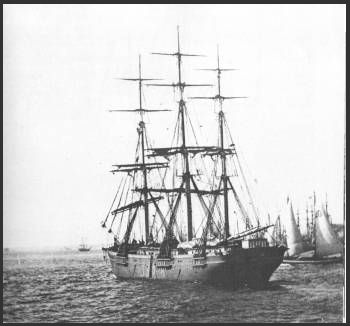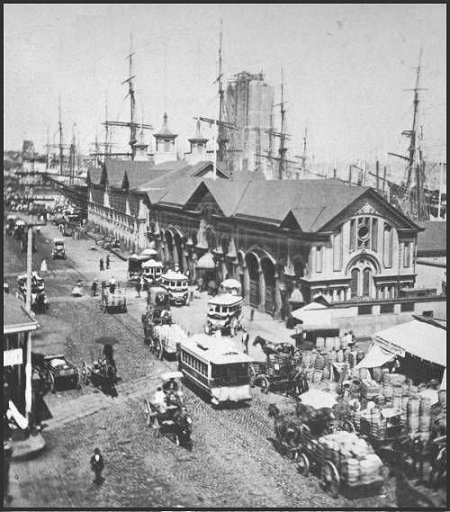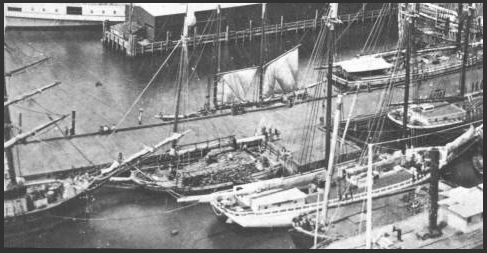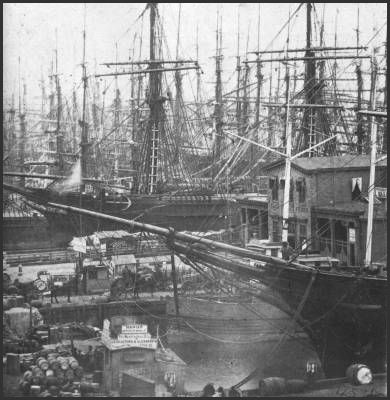
The Liverpool packet route is one of the most celebrated in maritime history. The competition was stiff among the involved companies, and here the development of bigger and faster ships was felt most. The business was in full swing when Luther Briggs arrived in New York City. Steamships were the crown jewels of the fleets. The Black Ball line boasted four of the most advanced ships, led for a time by the steamship Atlantic.1 A small group of captains held commissions to master these ships, and they were around well before Luther arrived in New York. Once you got a plum commission you held on to it, if possible. Luther apparently never captained a steamship. He may not have had the opportunity to master one. I lean toward thinking he preferred to sail his ships.
While manuevering for financial rewards, captains also had major responsibilities. Their positions depended a great deal on performance. For the owners, commercial cargo held the highest priority. The weather in the North Atlantic could be extremely dangerous and the loss of a ship and its merchandise was financially devastating. Delays, although often unavoidable, were bad for business. A slow-sailing captain could not expect to remain in high favor. Luther's length-of-passage record, to the extent that it has been found, was average, but he never lost a ship, and such dependability was surely valued by the mercantile companies. He appears to have been successful at increasing his financial gain while finding and keeping a foothold in what must have been a highly competitive business.
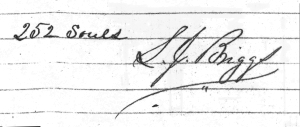
The immigrants brought to New York on the packet ships are known at times to have been treated very poorly. Luther's attitude toward this is unknown, but it's curious to see that he refers to them as "souls" on some of his passenger manifests. I haven't seen this elsewhere, so it was not common practice, at least. In any case, steerage conditions were never good regardless of who was at the helm. The earlier packet ships Luther commanded had only about six feet of clearance "tween decks" where steerage passengers stayed. They were assigned stalls and they were in them unless the weather was fair and they could go on deck. Otherwise, hatches were sealed and there was no ventilation. Sailing on the way to New York was rough against the prevailing western winds and the sea driven by them and seasickness was widespread. Disease, especially cholera and small pox, travelled easily in these conditions. Aside from the trip that required a quarantine, it's somewhat comforting to only find mention of only occasional deaths among Luther's immigrants, although they were mostly infants and children. There are two recorded trips during which crew members were lost. One fell off the jibboom (a precarious perch, just about the furthest out-front a sailor could go on these ships) and another from the fore yard.
Food was rationed in weekly portions and the passengers were provided only with a galley where they had to do their own cooking with their own utensils. The latter fact was unknown to most immigrants when they arrived to board their ships, and they were forced, if they could, to pay exhorbitant prices for such items at waterfront provision stores. The cabin passengers and at least the captain, perhaps also the mates, had a separate galley where a cook prepared their meals. These passengers had staterooms that opened to a saloon or parlor space decorated with fine woodwork. The distinctions between the decks, both physical and sociocultural, was a fact of life at the time. Larger ships such as Empire State and Victory had many more of those decks than the first packets, including the poop, saloon, upper and lower levels.
Luther isn't known to have broken any records; he didn't have a very long commission on a major ship; he probably didn't have the large personality that brought some captains to fame, and he came to the sailing packets after they had been eclipsed by steamships. It's likely for this that he left little mark in published histories on the subject. However, he had an excellent record, and given the relatively small number of packet vessels running the Liverpool route (supposedly 24 in the first half of the 1850s), it's surely notable that Luther found positions with the most prominent shipping companies and maintained this particular career for nearly 20 years. There were many smaller commercial ships plying the Atlantic Ocean, each with its own captain. However unpleasant the circumstances, he brought many "souls" from Europe to a new life in the United States. The number is about 9,750.
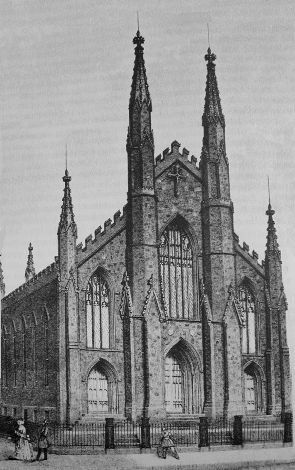
Little is known of Luther's life on land. The Briggs family lived in various townhouses in what is now the Brooklyn Heights neighborhood after they moved from Boerum Hill about 1857.2They stayed the longest at 46 (now 67) Joralemon Street (as mentioned withe the Marsh diary) and 168 Livingston Avenue. They attended the Church of the Saviour (First Unitarian Church) on Monroe Place in Brooklyn Heights. A newspaper report says that Luther was an assistant to the minister of that church in preparing for a large parade, and Luther, Jr., married his second wife there.
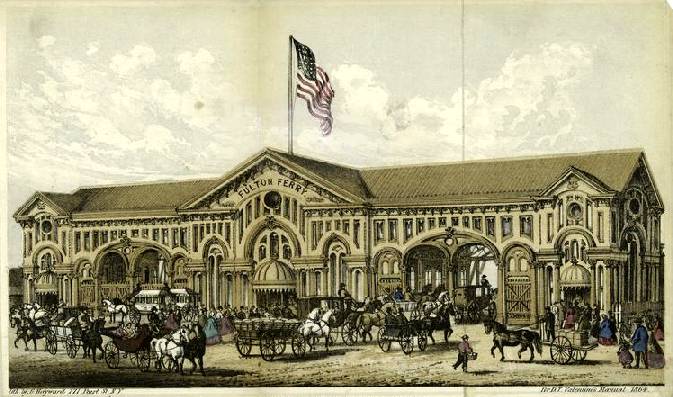
In April of 1884 he was appointed Inspector of Railroads for Brooklyn by William Fleeman, the City Works Commissioner. A 9 April article in The Brooklyn Daily Eagle says that "Briggs...passed a qualifying examination by the Civil Service Commissioners. Briggs was vouched for by Ripley Ropes [former City Works Commissioner and fellow First Universalist], I. H. Frothingham [a Gerrish relative] and W. L. Gervish [Gerrish, his brother-in-law]." He served for two years until a turn-over in city government from Republicans, in which party Luther belonged, to Democrats. An Eagle article dated 18 May 1886 says that newly-appointed City Works Commissioner Conner "accepted the resignations" of the existing inspectors and commissioners. Interestingly, all the new employees named were of Irish descent, reflecting the general division, politically and socially, between the more recently immigrated Europeans and the old New York and New England families. Perhaps enabling him to pass the aforesaid exam for Inspector of Railroads, Luther was involved in some capacity in the hardware business in Manhattan. The 1879 directory for Manhattan gives his occupation as "horseshoes," and the directory for the same year for Brooklyn says "sec., 65 Washington," "sec." usually meaning the office of Secretary of a company, but nothing likely was found in the directories. The 1880 census calls him a hardware clerk, and he was a clerk in the 1880 Brooklyn directory. Other New York and Brooklyn city directories give his occupation variously as "hardware" and "nails." Hard to say what this all actually means. Newspaper articles say he was a member of the Alcyon Boating Club of Brooklyn, which held races off Fort Hamilton.

In the 1890s, Luther, over 10 years a widower, moved to Fanwood, New Jersey, to live with his son Luther, his wife Ada and their children Mariana ("Mayzie") and Russell.3 On 4 January 1894, Luther died at his former home on Livingston Avenue, Brooklyn, which was then occupied by his sister-in-law Rebecca "Aunt Beck" Thornton, his granddaughter Mary and her husband Otto C. Wierum, Jr. Perhaps he had been visiting them when he became ill. He died after suffering a week of pneumonia.4 He's buried in the Briggs plot in Green-Wood Cemetery with Harriet, Luther, Jr., his daughter-in-law Mariana, his grandson Benjamin B. Briggs and "Beck" Thornton. This plot is three away from Mary, Jr., and Harry. The plots were bought by Luther at the same time, but why two different plots? Gray family members were buried in the first one soon after Mary and Harry and they eventually bought the plot from Luther. The head of that family was Rev. William Gray, who was a Presbyterian evangelist. In later years he was associated with the First Presbyterian Church in Manhattan, but no connection between this church, or Gray, and the Briggs has been found. It's interesting to also note that two plots away from the elder Briggs in the other direction is a plot for the di Zerega family, who were very prominent shippers and ship captains. They surely knew each other.
There's nothing said about Luther in the family's oral histories aside from what appears in his obituaries. The Marsh diary is invaluable for this reason. From that we know his nickname was Lute, but his granddaugther Mary (Briggs) Wierum, who was raised by Luther, Mary and Aunt Beck, said that he was referred to within the family as "The Captain."5 I hope this was said fondly. After he died, his daughter-in-law Ada emptied his sea chest and whatever was in it - we'll never know - she burned. Her stepdaughter (also her niece) Harriet (Briggs) Smith was furious that she didn't ask anyone first, and it's hard not to think some animosity was going on. There was one bit that escaped the fire, a sheet of navigation coordinates, but this and the chest were deemed unsalvagable after Hurricane Katrina over a century later.
One of his obituaries says "Sad are the hearts of the favored few who, in the last years of the Captain's life, knew and loved him well. He was hale and hearty to the last, with ever a word of sympathy for the afflicted, yet rejoicing in the joy of others. The news of his unexpected demise struck a blow to all. Strong as he was in his preferences for personalities, still may it be truthfully said that never did he let fall a word derogatory to any man's reputation."
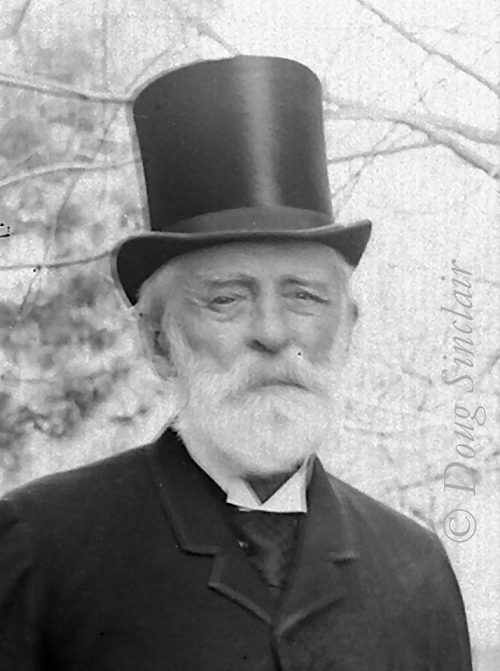

Be sure to look at the photos below after the footnotes.
children of Luther and Mary (Thornton) Briggs:
i. Thornton b. 20 July 1843, Brockport, NY, d. 29 September 1898, Boston, MA, m. 1. Mary Louise Frere, 2 children, 2. Mary Frances Bullinger
ii. Luther Jenney b. 6 July 1845
iii. Mary B. b. 1852?, d. 26 December 1855
iv. Henry Russell, b. 18? October 1853, d. 18 January 1856
|
|

1. Family lore says that Luther was master of the steamship Atlantic in 1855. There was a "Capt. Briggs" who stepped in for her regular captain for one trip in that year. The passenger manifest reveals that he was George Briggs. Luther isn't on record as ever piloting a steamship.
2. Brooklyn city directories.
3. One of his obituaries and his death certificate say he was of Fanwood and that he died in Brooklyn.
4. New York City death certificate, Brooklyn #156.
5. The 1850 census says she was 11. Given that Luther sailed out of town in May 1838, Mary was conceived probably over the previous Winter. There is no evidence found that she died before 1855 and another child born who was named for her, but Mary's death notice says she was 4. This may be a typo, and 14 was intended. She was placed in a receiving vault at Green-Wood Cemetery on 28 December, as was Henry after he died. They were buried after Luther bought the plots there the following June.