"The Washington"
After having bought the premises on 27 November 1848, the owners of an old Georgian-style house at #1 Broadway eventually raised it two stories and connected it to a house behind it at 1-3 Battery Place. The Broadway building was famous for being one of Washington's headquarters during the Revolutionary War. #1 Battery Place was where Robert Fulton of steamboat fame died. Jonas obtained a lease for the building and left the Bowery to create "The Washington," a hotel that one contemporary source infers was a conservative concern "kept on the European plan and sport[ing] fine punches." (10)

#1 Broadway, as it looked while still a residence.

This engraving compares well with what can be seen in the photo above. The "WASHINGTON HQRS" sign was a fabrication by the engraver, but there was a sign saying "WASHINGTON," which appears on another engraving. fn There was hotel elsewhere in the city called "Washington Hotel."


James Bennett continued to be hyperbolic and sarcastic in his articles in the Herald long after Jonas' days in the circus business. His approach, which was mirrored in his personal dealings, got him in trouble, but it did provide some entertaining reading. When Gov. John King visited Manhattan in November of 1857, he arrived at the Battery at the tip of the island. Many regiments of local militia under Gen. Sandford had gathered for the governor's review.
"The weather was bitter cold, and the piercing wind, sweeping in from the open sea, chilled through the devotees...till their teeth chattered and knees smote against each other. It was in vain that they piled their arms, stamped their feet, clapped their hands and rubbed their noses...After enduring the cold till it was almost insufferable, they got excused for fifteen minutes, and by means of the comforts and refreshments of the Washington Hotel, restored their bodies to a natural, perhaps unnatural, degree of heat...
Gen. Sandford and the governor with their staffs were greeted in front of the hotel, then went in "where refreshments, consisting chielfy of wine and sandwiches, were partaken of." After this the governor made his way to review the regiments before moving on as a procession north into the city. "Meanwhile, thousands of women and children were kept waiting in the piercing cold along Broadway and Fifth Avenue, many of whom will soon die of consumption, the seeds of which were sown yesterday."
A description of the hotel is given in an 1862 article in the New York Times. The article laments the destruction of the city's old landmarks and chose #1 Broadway as an example, partly due to its associations with the Revolutionary War. The reporter describes the interior as though it looked the same during the Revolution. An engraving below suggests it was remodelled in the Greek Revivial style, likely when the building was enlarged about 1847-1848. The decorations are definitely not Georgian, but the writer imagines they were. Although the article is washed with romantic confusion, it does give a good idea of the inside of the hotel when the Bartletts were there.
[The] house seems to have been so excellently built for the accomodation of friends that when changed into a hotel hardly any alterations were necessary. The gentleman who directs it has made it his special care to preserve as much as possible the antique furniture and decorations of the place. On entering the fine square hall, the parlors are to the left, the rooms to the right being rented to a physician who has a taste for antiquarian pursuits. The doors opening on the hall are of moderate dimensions, but on entering the rooms one is at once struck with their size and their extreme height. There are two parlors connected with folding doors of enormous size, supported by oak columns in the Ionic style [likely one of the Greek Revival elements], for this period was the decadence of the glorious renaissance. This suite was evidently in Capt. Kennedy's [the man who had the house built] time the withdrawing rooms, and were most elaborately decorated. In the first the mantel-piece is in the purest white marble, and represents the facade of a Greek temple. On each side are two columns with capitals of acanthus leaves, but not correctly in the Corinthian fashion. Above there is a frieze of acanthus ornaments, with a central tablet of Cupids, male and female, devouring grapes. At the extremities, over the columns, are female heads, with loose curls and amaranths studding their hair, the whole surrounded with a wreath of myrtle, terminated by a heraldic scroll. Immediately under the frieze, and directly over the fire-place, is an arch of white marble, with brackets along the throat of the arch, and more wreaths of myrtle and more scrolls in the architraves. The key-stone of the arch is a fine head of Bellerophon in mezzo relievo. All the rest are curved in very low relief, and with little spirit. It is evidently an importation from England and a copy of a bad French model, but it must have been terribly expensive. The mantel-piece in the next of the suite is much plainer, being of black marble, bleu belge, which is perfecly pure, without mottlings, and Egyptian, which is marked with yellow. There are in each immense mirrors, reaching from the ceiling, which has a very plain cornice, down almost to the ground, a height of nearly sixteen feet. They were once gorgeously gilded, but at present they present a somewhat shabby appearance.
In the second room which, with large folding doors, connects with what was the dining room, but is now the bar and offices, the mirrors here have slabs of marble attached to bear coffee-cups and plates of thin bread and butter and comfits, for it was the fashion in those days for the gentlemen when they came from their wine to get their coffee and tea from the mistress of the house themselves without the aid of servants, and to wander about the drawing rooms, sipping and chatting and examining works of art and virtu. To sit down was to be boorish, or to confess tacitly that one had taken too much wine. There were no etageres of bubl and ormolu to rest things upon, or if there were they were occupied with gimcracks and flowers. The little marble slabs stretched out from the mirrors were the only havens for the visitor tired of carrying his cup of Mocha, or Souchong. These, in this mansion, are supported by pediments of bronze that, perhaps, were gilt in part, in the old times of the Kennedy or the Loring receptions. These pediments are fashioned in the upper part like winged victories; but out of the four figures only one preserves her wings intact, two being altogether deprived, and the third having a part of one. The faces were originally very beautiful, for the workmanship of these is very superior: but time, and, perhaps, the kicks of drunken guests, have given to them a peculiarly grim and sarcastic look except one, the abrasion of whose nose has given her an aspect of conviviality immensely jovial. The staircase is broad, the steps being so modulated as to give the least possible fatigue in mounting. The bannisters are of mahogany, which in the rails is becoming black through age. Here the modern houses have the advantage, for the old bannisters are stiff and angular and in every respect inferior to those now in vogue. The passages in the upper floors have now become dark, not only by reason of the additions to the house itself, but also from buildings that have grown up by its side and in rear, which block up the windows somewhat unpleasantly. Above, on the roof, is the remains of an observatory, from which a splended view can be obtained.
We are then supposed to imagine Tories watching the approach of the water-born American army from this spot, even though it post-dates the war by about 70 years. The observatory is likely the flimsy-appearing structure on the roof in the engraving above.

This interior image of "The Washington," circa 1860, is an anachronistic view of George Washington, probably meeting with Maj. John Andre, in a nostalgic reference to the use of the 18th-century building as Washington's local headquarters during the Revolution. This is how the hotel would have looked when Jonas ran it.
Jonas inevitably came into contact with many prominent people as a hotel, circus and military man. Ex-President Van Buren, Gov. King, Cornelius Vanderbilt and the Astors evidently among them. Another was P. T. Barnum. Barnum's early career in New York was spent partly on the Bowery when the Bartletts were there, and they undoubtedly met then. He had started his "American Museum" of curiosities on Broadway not far from "The Washington" years later. He built a house in Bridgeport, Connecticut, and became involved in the economic development of that city. A bad investment not only bankrupted him but affected Bridgeport as well and he was made a scapegoat for the resulting problems. The situation was so bad that a number of friends and associates in New York came to his defense and offered to help him recover financially. One offer was made in the New York papers, including a list of men who volunteered their public spaces for fundraising events. Among them was Jonas.
Another Barnum with whom Jonas came into contact was "J. S.," a visitor from the western part of the New York State. Their acquaintence was brief, given that Barnum died 11 hours after they met. The following coroner's account, dated 7 August 1852, tells why:
Jonas Bartlett, being duly sworn says I am the proprietor of the Washington Hotel. Deceased came to my house and took lodgings about 8 1/2 o'clock, took his supper, then took a walk on the Battery. He drank nothing. He came in about 10 1/2 o'clock and retired to bed. He stated that he wished to be called at 6 o'clock. He was going to [New Haven?]. At 12 1/2 o'clock I heard a tremendous crash and looking in the back building I saw that the ceiling had fallen off and looking open the top building I saw the deceased lying there [the account, written on site by the coroner, is not completely coherent]. [unreadable and ink smeared] to him and in about 10 minutes Dr. Andrews came in. He was not dead, was insensible and continued so while at my house. Dr. Andrews examined him. He thought he was suffering from concussion. The Doctor advised his removal to the hospital which was done. The window [of his room at the hotel] was raised. He slept in no. 33. He fell from the 4 story upon a 2 story rear building.
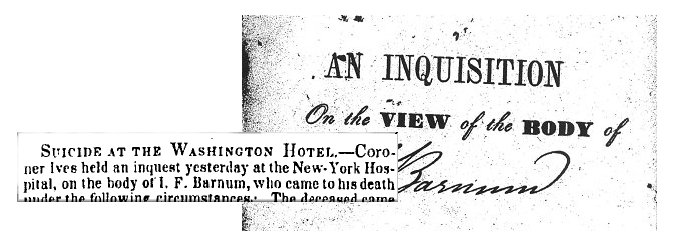
The deposition was signed by Jonas. Joseph Box, superintentant at the hospital, deposed that Barnum came to the hospital about 2:30 AM. A doctor cut the hair from the front of Barnum's head, presumably to examine the wound, and decided "it was of no use to apply remedies, he was too far gone." However, he lingered for 5 hours and died about 7:30 AM.
Papers then reported that he committed suicide based on the erroneous claim that the coronor's report made that conclusion. The story takes an odd turn with the reason the papers reported it in the first place. Two doctors named Nicolas, of Paris, and Pilate, of New Orleans, had purchased the right to use a proprietary method of embalming from the man who invented it in France. These doctors were at City Hospital when Barnum died there, and took the opportunity to use this method, supposedly for the first time in this country.fn The method differed from those traditional by theoretically preserving the body indefinitely rather than long enough only to get the deceased to their burial. In this case, the purpose was likely to preserve Barnum in order to get him back home in the middle of a hot spell in August.
The embalming took place three or four days after Barnum died. Reporters were allowed to view the body. One editorial says "although under quite unfavorable circumstances, the body remains free from the least unpleasant odor, and with but little change, except what has arisen from the drying up of the tissues somewhat, owing, in a considerable degree, to its imperfect protection from the air." (The New York Medical Times, vol. 2, p. 22, Oct 1852) Another said "The doctor merely opened the carotid artery, and injected a substance, know only to humself, into it. The effect was wonderful. The body commences daily to grow harder and harder, and is now in a condition which the doctor assumes neither time nor climate can affect." Also, "it requires only an hour, and a small incision in the artery is the only cutting done to the body...though the weather had been so extrememly hot, there was not the slightest discoloration." (Syracuse Daily Journal)
The Christian Advocate published a letter to the editor from friend of Barnum's taking issue with the claim of suicide. "Circumstances show that having been seated on the window sill of his bedroom, to get the favor of the cool evening air, he dropped to sleep, and accidentally fell from the window." He was by all other signs a contented family man who had his own farm. However, no money was found on him or in his room and he had asked Jonas where he could find P. T. Barnum, who was no known relation. The writer apparently was a friend of the family, and "at the time of the funeral, on the tenth day after embalming, the body was in a perfect state of preservation, and, to all appearances, would remain so for years. The features appeared more rigid than when in life, and the flesh of an ashy hue, and appeared to be growing harder every day." He ends his letter informing us that "the price of embalming a body is $25 for one class, and $100 for another. For the last named price, the natural colors of the flesh are retained."
The 1855 census lists 45 residents and 18 staff members at "The Washington." (11) The residents (likely not travelling guests but boarders) were mostly professionals and tradespeople. While some rooms surely were available for short-term stays, the capacity of the hotel hasn't been found. Jonas is listed for the first time in city directories at this address in 1849-1850. Daughter Ada Bartlett told her family that she rolled hoops across the street in Bowling Green, a little public park that still exists. Jonas continued to operate the Branch Hotel in absentia with his partner Delavan. The 1851 directory of occupants of city buildings by street address lists the hotel there and two proprietors: "John" Bartlett and William A. Delavan. Delavan is listed sporadically in directories of the period and with various occupations, but he may have been the primary proprieter at the Branch Hotel after Jonas moved to Broadway. Nothing has been found about how long Tom Hyer ran that hotel, but apparently not for long. Jonas also had a partner at "The Washington," at least briefly. The 1854 directory lists him as E. S. Biddell. He may have been the same as or a relative of Sylvanus Biddle, who later sold Jonas property in the Cobble Hill neighborhood of Brooklyn.

1.
all text and photographs © 1998-2022 by Doug Sinclair unless where otherwise noted