
go to Ruth Pickworth's page
| one line of descent | father | index | home |
go to
Ruth Pickworth's
page
Nathaniel of Manchester and Wells, then in Massachusetts Bay Colony, and shouldn't be confused with Nathaniel Masterson of that colony in Ipswich and York. Nathaniel of Manchester/Wells is referred to several times as Nathaniel Masterson, adding to the confusion.
Circumstantial evidence shows that Nathaniel was the son of Thomas Masters of Southwark, England, and his wife Lydia.1 He was baptized on 27 January 1626/7 at St. Saviour's church, now known as Southwark Cathedral. His father was a silk weaver, but he seems to have been a pauper. He died before his children were grown, and his will left little other than a bequest of books to his sons Abraham and Nathaniel and his brother-in-law Michael Dobinson. His father, who had settled in Cambridge, Massachusetts Bay Colony, left Abraham and Nathaniel money. Abraham was given less, since his grandfather may have paid for his apprenticeship. Nathaniel, his aunts Lydia, Elizabeth and Sarah, and his first cousin John Lockwood were given £10. Nathaniel became a tailor. English records show his grandfather was also a tailor, so Nathaniel may have been sent to New England an anticipation of apprenticing with him. Nathaniel was 12 when John Masters died. Alternatively, the £10 may have gone toward an apprenticeship in England. In either case, he was in New England by 1650.
John Pickworth, Nathaniel's father-in-law, was of Salem but apparently went to Plymouth to marry in 1631.2 He was back in Salem by 1638, when he and his wife Ann joined the church there.3 Their daughter Ruth was pregnant with Nathaniel's child before they married. In colonial New England this was illegal, and Nathaniel was called to court for it on 29 June 1654. It was revealed that they "fornicated" at Pequot Harbor, now New London, Connecticut.4 Why was Ruth there and not Salem? John Pickworth had been given land in New London in 1651 which he eventually forfeited from lack of settlement on it,5 but he and his family must have lived there, however temporarily. Cary Latham, Nathaniel's brother-in-law, was there at the same time. He sold the Masters homestead in Cambridge in 1645, which he and Elizabeth had inherited.6 He was chosen a selectmen of Pequot Harbor 22 Feb 1648/97 Nathaniel had a land grant there on 16 February 1649/50.8 He was fined at Pequot court for being drunk in public on 25 April 1651.9 He's among the men on a list of those who helped built the mill dam in Pequot in July 1651.10
There isn't a record of Nathaniel in any town after Pequot until 7 November 1659, when he's on a list of people who paid the Salem constable for unidentified reasons.11 There is no evidence of him in Pequot again, and he may have sold his property there by then. He had a house in what is now downtown Beverly bounded by Wallis Street, Broadway and what used to be the shore of Bass River, now Rantoul Street.12
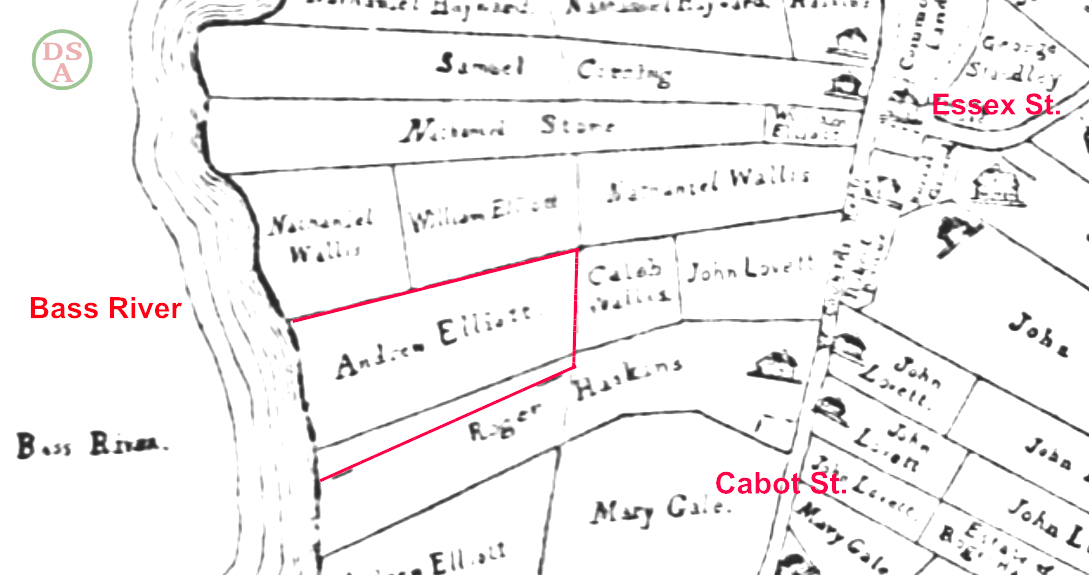
There isn't a record of when he was granted or bought it, nor is there for his neighbors, but he sold it in 1667.13 This was likely when he transition from Salem to Wells, now in Maine. Wells granted him land for a homestead in 1666 and more land in 1669.14 On 7 July 1670, he took the freeman's oath in Wells.15 He's mentioned as the father of John "Maisters" in a Wells apprenticeship agreement in 1674.16 He was fined for cursing at a militia man in Wells who confiscated his gun in November 1676.17 He testified in a York County court case on 2 July 1678.18
On 4 February 1677/78, he deposed in a case involving two Salem seaman, aged about 47 and referred to as "Mr."19 There was an active maritime trade between the North Shore towns above Boston and the towns in southern Maine in fish and lumber, so without other evidence of his being in Essex County at this time, at may be that he encountered these men in Wells. His sons John and Abraham, who were very young men, had land grants in Wells on 6 December 168120. Nathaniel was of Wells when Moses Littlefield sold him land there in 1685.21 An agreement with the town of Manchester in Essex County to allow him wood from the common land to build a house in 1690 infers he had or intended to move there.22 There must have been a deed for it, but there is nothing recorded. Despite this obvious and lasting presence in Manchester, Nathaniel kept his real property in Maine to his death. Abraham married a woman from Manchester in 1691. His youngest sister, Rebecca, married there in 1692.23 Her sister Lydia married a Wells man in 1698, and her sister Ruth married another Wells man about the same time.24 Being an older man, he doesn't appear much in service to the town. In May 1695, he was chosen grand juryman for the Quarterly Court.25 66 In an assessment for covering the costs of the new meeting house in tax and labor he was assessed 10 shillings.26 The last mention of him is in March 1701/2, when he was chosen a tithingman.27
Nathaniel died in Manchester on 19 March 1707/8. His estate started to be settled soon after. An inventory was taken and an adminstration account made by Ruth, but the estate appears to have gone into limbo. The only mention of the Maine property at that time was in the estate inventory, referred to as "a parcel of land and meadow in Wells" with no value listed.28 Abraham's son Nathaniel was chosen the administrator of both his and his grandfather's estates in 1714. It was then that the Maine property was inventoried. Ruth (Pickworth) Masters died in 1713, which may have prompted the family to finally deal with property. Nathaniel, at only 21, was chosen to administer the Maine property and was co-administrator of his father's estate. There are several reasons to speculate why he was chosen administrator for his grandfather when he had uncles who were still alive. Abraham was likely Nathaniel's oldest son and his son Nathaniel also an oldest son. Nathaniel sold it to Samuel Brown of Salem on 7 September 1715.29
Grandson Nathaniel, who signed his name "Marsturs," was granted permission by the York County Superior Court on 24 August 1715 to sell the Wells real estate in Wells, which included a hundred acre farm and orchard "on Ogunquit side."30 The main village within Wells Township was Ogunquit, which separated to create its own township in 1980. Most of the land was given to Nathaniel, Sr., by the town of Wells in 1666 and 1669. Other parcels sold were a piece of salt marsh and an island of thatch, all at or near Wells harbor, and a "fresh meadow," probably referring to a fresh water marsh, known as "Masters Meadow."
Nathaniel died without a will. The estate didn't go to probate until 6 November 1715.31,
The following is taken from his estate documents, with modern spelling and paraphrasing:
An inventory of the estat of Nathaniell Mastus late of Manchester who deceased on the 18th of March 1707/8
Real estate, housing, land, and meddow in Manchester 4 acres upland, 1/2 meadow £30
also a parcel of land and meadow at Wells
Personal estate, two cows and a calf, £5
swine £1, 10 shillings
a bed and bedding £3, 10 shillings
wearing clothes £3, 16 shillings
pewter and brass £1, 2 shillings 6 pence
ironware £1 8 shillings, 6 pence
woodenware £1 8 shillings, 6 pence
earthenware and glasses 2 shillings
two guns and a saddle £2, 10 shillings
John Siblee
John Ley
John Alllin
appraisers
Ruth swore to the accuracy on 5 July 1708.
Ruth's administration account, not dated:
credits:
real estate from inventory £30
personal estate from inventory £20, 7 shillings
debts:
funeral charges £2 3 shillings
John Knight £8
Matthew Annable £3, 11 shillings
Abigaill Masters £1
Samuel Lee £2 9 shillings
John Lee 1 shilling 6
Samuel Lee for board from 1708 to 1715 £20 4 shillings
mony lent by my said son £8 19 shillings 6 pence
bond & letter of administration & inventory & journey to obtain a power of attorney & expences 15 shillings
appraising and recording the account 3 shillings
allowing the account 5 shillings
petition & certificate to the Superior Court & copies 6 shillings
a quietus (surely for a settlement of a debt) 4 shillings
allowed the administratrix for time & trouble £2
allowed the favor of law (her dower) to the widow, bed & bedding as inventoried £3 10 shillings
£42 15 shillings
another account was made on 3 July 1708, which is similar to the one above:
funeral charges £2 3 shillings
expences of administration 15 shillings
Capt John Knight 8 shillings
Matthew Anable 3 shillings
Abigall Marstus, paid for attendance of myself & husband in his life time £1
paid to my son Samuel Lee for work at sundry times £2 9 shillings
John Lee 1 shilling 6 pence
and what I have run in debt to my son Samuel Lee in my widdowhod is yet to be paid, I would crave your honor's advise to be assisted to pay the debts
Ruth Masters [with her mark]
witnesses
John Ley Senr
Samll lee Juner
A separate probate case with grandson Nathaniel as administrator was opened in Wells to deal with the real estate there:
An inventory was presented at court on 28 April 1714:
150 acres of upland £28
9 acres of salt marsh £24
10 acres of fresh meadow £5
appraised by Dependence Littlefield, Samuel Stewart and Josiah Winn
Nathaniel gave is administration account on 9 May 1715:
credits:
real estate £57
debts:
bond & letter of administration, recording the inventory, etc. 19 shillings, 3 pence
expenses of three appraisers for 3 days £3
allowing the account, selling and dividing the real estate, quietus, etc 12 shillings, 6 pence
administration expences: 2 journeys from Manchester to Wells, time & trouble, etc. £5
due to Abraham Mastes estate as the account as appears in his book, on balance £31, 16 shillings
total £41, 7 shillings, 9 pence
surplus £15, 12 shillings, 9 pence
Nathaniel gave oath that "the accompt of thirty one pound sixteen shillings is just as appears in my Father Abraham Marstes decd his book due from the estate of my grandfather Nathll Marster's decd." There is no record of a division of the estate either in Manchester or Wells.
Children of Nathaniel Masters and Ruth Pickworth:
i. Nathaniel?, b. say 165433
ii. John, b. say 165834
iii. Abraham, b. say 166035
iv. Ruth, b. say 166336
v. Lydia, b. say 1666 37
vi. Samuel, b. say 167038
vii. Rebecca, b. abt. 167539

1. Parish register of St. Saviour, Southwark, England, Ancestry.com image database online.
2. The New England Historical and Genealogical Register, vol. 2 (Boston, MA: New England Historic Genealogical Society, 1848), 242.
3. Richard D. Pierce, ed., The First Church in Salem, Records, 1629-1736 (hereafter FCS) (Salem, MA: Essex Institute, 1974), 7.
4. Records and Files of the Quarterly Courts of Essex County, Massachusetts, vol. 1 (Salem, MA: Essex Institute, 1911), 360.
5. Frances Manwaring Caulkins, History of New London, Connecticut (New London: H. D. Utley, 1895), 77.
6. History of New London, Connecticut, 58.
7. The Register Book of the Lands and Houses in the "New Towne" and the Town of Cambridge (Cambridge, MA: 1896), 119.
8.History of New London, Connecticut, 60.
9. Records of the Particular Court of Connecticut, 1639-1663 (Hartford: Connecticut Historical Society, 1928), 98.
10. History of New London, Connecticut, 74.
11. "Town Records of Salem, Massachusetts," in Essex Institute Historical Collections vol. 9, 2nd series, vol. 1 (Salem, MA: Essex Institute, 1868), 229-30
12. Sidney Perley, "Beverly in 1700," Essex Institute Historical Collections, vol. 55 (1919), 285.
13. Essex Co., MA, deeds, 3:42
14. Referred to in later deeds beginning with the sale by Nathaniel (3), son of Abraham (2) in 1715. York Deeds, 8:182
15. Charles Thornton Libby, ed., Province and court records of Maine, vol. 2 (Portland, ME: Maine Historical Society, 1931), 194.
16. York Deeds, 2:311.
17. Province and court records of Maine, 2:511.
18. Province and court records of Maine, 2:344.
19. Records and Files of the Quarterly Courts of Essex County, Massachusetts, vol. 7 (Salem, MA: Essex Institute, 1911), 106.
20. The history of Wells and Kennebunk 187
21. Essex Co., MA, deeds, 11:533.
22. Town Records of Manchester, vol. 1 (Salem, MA: 1889), 38.
23. Vital Records of Manchester, Massachusetts, to the end of the year 1849 (Salem, MA: Essex Institute, 1903), 197.
24. The Littlefields lived in Wells. They likely had Nathaniel baptized there as a gesture to the honorific and wanted to directly involve her parents. Although there was a meeting house in Manchester, 1698 was evidently a transition year for the local ministry (Rev. D. F. Lamson, History of the town of Manchester, Essex County, Massachusetts, 1645-1695 (Town of Manchester, ca1895), 224.
25. Town Records of Manchester, 66
26. 26 July 1696, Town Records of Manchester, 73.
27. Town Records of Manchester, 98.
28. Essex Co., MA, probate file 12684, see also vol. 2:92, 100.
29. Essex Co., MA, deeds, 8:109
30. York Co., ME, probate (transcription volumes), 2:92-3.
31. Essex Co., MA, probate file #17833.
33. Nathaniel "Sr." made a complaint to the court in November 1676 (see note 17). A Nathaniel Masters served as a soldier from Wells in 1676-7, suggesting this was a son rather than the father, who was about 50 (James Phinney Baxter, ed., Documentary History of the State of Maine, vol. 6 (Baxter Manuscripts) (Portland, ME: The Thurston Print, 1900), 195).
34. John's 1674 apprentice record in Wells, now in Maine, names father “Nathall Masters” (York Deeds, vol. 2 (Portland, ME: 1887), 159). He and Abraham had a land grant together in Wells in 1681 (Edward Emerson Bourne, The History of Wells and Kennebunk (Portland, ME: 1875), 187; York Deeds, vol. 18 (Bethel, ME: 1910), 26).
35. Abraham's son Nathaniel was the executor of his grandfather Nathaniel's estate and described as his grandson and son of Abraham (York Co., ME, probate file 12684, FHL film 2293373, image 106; York Co., ME, probate records, 1687-1938, 2:92a-b, 100a, FHL film 12782, images 265, 273). Abraham eventually settled in Manchester with children Nathaniel and Ruth, among others (Vital Records of Manchester, Massachusetts, to the end of the year 1849 (Salem, MA: Essex Institute, 1903), 91).
36. The surname of Ruth, wife of Jeremiah Storer, may be speculative and based on location and children's names. Among the latter are Nathaniel and Ruth, named in his will (Suffolk Co., MA, probate file 5971).
37. The baptism of Josiah and Lydia Littlefield's son Nathaniel says Nathaniel Marsters of Manchester was Lydia's father (Records of the First Church in Beverly, Massachusetts, 1667-1772 (Salem, MA: Essex Institute, 1905), 118).
38. Samuel and his wife Anne's first child was named Ruth, b. 1699 (Manchester vrs., 91).
39.Rebecca Masters has a marriage record in Manchester to Samuel Lee, and they had Ruth, b. 1697, and Nathaniel, b. 1703 (Manchester vrs., 82-83, 196). Gravestone in Old Burial Ground, Manchester, d. Nov. 1713, age 48, image at Find a Grave, memorial ID 85790677, accessed August 2025. Ruth (Pickworth) Masters, executor of Nathaniel's estate in 1708, refers to Samuel Lee as her son in her administration account. She sold the Masters Manchester homestead to Samuel (Essex Co., MA, deed 29:253).